
Kerala has overtaken more industrialised states in personal electric vehicle adoption, driven by strong middle-class uptake, policy support, and charging infrastructure.

Passenger vehicle dispatches from companies to dealers raced to the highest ever sales mark in a calendar year in 2025 as a reduction in prices due to GST reforms led to robust sales in the festive season, industry body SIAM said on Tuesday.
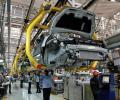
Automobile retail sales in India rose 6 per cent to 2,61,43,943 units in FY25 with rural areas performing better than urban regions across passenger vehicle and two-wheeler segments, dealers' body FADA said on Monday. The last financial year saw growth in sales of passenger vehicles, two-wheelers and three-wheelers.

After two years of strong gains, smallcap stocks fell sharply in 2025, but the correction may be setting up opportunities for long-term investors.

The fiscal tilt towards capex benefits companies in investment-related sectors like capital goods, defence equipment, engineering & construction and metal & mining. The planned cut in revenue expenditure will weigh on companies in consumption sectors like FMCG, consumer durables and retail.

Electric passenger vehicle (PV) retail sales jumped more than twofold in September with Tata Motors (TaMo) leading the pack having over 6,000 registrations and a 40 per cent market share.

India's two-wheeler industry is seen growing 6-9% in 2026, though a proposed ABS mandate for sub-125cc models could push up prices and temper volumes.

Multiple tailwinds for the automobile sector, including a cut in goods and services tax (GST) rates, are keeping analysts bullish on auto stocks from a long-term perspective, even as they see the rally running its course in the near term.

Equity markets this week would keenly track the upcoming GST Council meeting, macroeconomic data announcements and trading activity of foreign investors for further movement, analysts said. Moreover, developments related to tariff negotiations, global market trends and auto sales data would also drive investors' sentiment.

The growth momentum that started during the festival season is likely to sustain in the new year, reports Arindam Majumder.

Auto majors Maruti Suzuki, Tata Motors and Mahindra & Mahindra reported robust sales in September as reduced price tags owing to GST rationalisation led to record demand in the Navaratri period. The month also saw Tata Motors and Mahindra & Mahindra settling at number two and three positions, respectively in vehicle wholesales ahead of Hyundai Motor India.

Passenger vehicle retail sales shot up 35 per cent year-on-year during the nine-day Navratri period this year, helping the overall registrations last month grow 6 per cent, as offtakes remained muted in the first 21 days of the month and only took off after the roll-out of new GST rates on September 22, dealer' body FADA said on Tuesday.

Mexico on Thursday imposed a tariff of up to 50 per cent on imports from its non-preferential trade partners, including India, a move that might hit New Delhi's annual $5.75 billion shipments to its third-largest car export market.

India's electric two-wheeler (e2W) manufacturers have urged the government to extend subsidies under the PM E-Drive (Electric Drive Revolution in Innovative Vehicle Enhancement) scheme beyond March 2026, cautioning that a withdrawal could slow near-term demand even as confidence in long-term electric mobility adoption remains intact.

Passenger vehicle dispatches from companies to dealers increased 19 per cent year-on-year in November as demand remained robust post festive period, industry body SIAM said on Friday.

Shares of tyre manufacturers have outperformed broader equity benchmarks, buoyed by multiple tailwinds. Softer raw material prices, an uptick in demand from automakers following the reduction of the goods and services tax (GST) rates, and steady replacement demand have lifted sentiment toward the sector.

As per SIAM data, vehicle sales across categories, including passenger vehicles and two-wheelers and commercial vehicles stood at 18,21,490 units last month as against 23,82,436 units in August 2018, a fall of 23.55 per cent.

After the easing of lockdown in mid-May, auto companies were able to resume production in a phased manner, but the ramp-up was slow due to a broken supply chain, and lockdown-induced restrictions.

'Growth will definitely continue to come most from the sub-four-metre SUV segment, primarily because that is where the heart of economy and affordability is. Naturally, that will keep pushing the share of that segment (in overall PV sales) higher.'

Czech carmaker Skoda plans to bring more of its global nameplates into the Indian market as it looks to cater to a diverse set of customers, according to a senior company executive. The company, which now sells products in India ranging from over Rs 7 lakh to upwards of Rs 40 lakh, however, has no immediate plans to introduce electric cars in the country.

Maruti Suzuki India plans to localise battery production and other critical components over the next few years as part of strengthening the overall EV ecosystem in the country. The company, which plans to launch its first electric vehicle - e VITARA in the domestic market next year, is looking to instill confidence in the buyers as it looks to strengthen the overall EV ecosystem.

Auto sales, particularly of two-wheelers, may not bounce back immediately and may take another two months to come back on track even as car bookings have started seeing an initial uptick. Various states started Unlock 2.0 on Monday, following a fall in the number of Covid-19 cases. Auto sales were hit in May following the impact of Covid-led lockdowns.
Automobile (auto) retail sales in India grew by an impressive 14 per cent in July compared to the same period last year, driven by a surge in the rural economy, good product availability, and product launches. While passenger vehicles (PVs) saw a 10 per cent increase during this period, inventory levels have surged to a historic high of 67-72 days in PVs, equating to Rs 73,000 crore worth of stock, according to the Federation of Automobile Dealers Associations (Fada). This poses a risk to dealer sustainability. Inventory levels in July 2023 were only 50-55 days, equating to a stock worth Rs 49,833 crore. In June 2024, inventory was between 62 and 67 days, with a stock value of Rs 60,000 crore.

Yamaha expects its first EVs to hit showrooms by the last quarter of FY26 (January - March), once network readiness is complete.

Japanese auto major Honda considers India a key market for its future growth alongside the US and Japan, according to Honda Cars India President and CEO Takashi Nakajima. The Tokyo-headquartered automaker, which operates in India through a wholly owned subsidiary, plans to drive in more SUVs in the country, as the segment continues to see robust sales across varied price points.

Starting January, the market is expected to welcome models like the Tata Punch 2025 which is expected to be around 6 lakh, Mahindra BE 07 EV around 29 lakh, Maruti WagonR Electric around 8.5 lakh, Toyota 3-Row SUV around 14 lakh, and Volkswagen Tera to be around 8 lakh.

Leading automakers Maruti Suzuki, Hyundai and Tata Motors on Thursday reported robust sales in March as a shift towards personal mobility and pent up demand continued to help companies push dispatches to their respective retail partners. Toyota Kirloskar Motor, Honda Cars and Mahindra and Mahindra (M&M) also reported strong sales last month as compared to the year-ago period, when dispatches were adversely impacted due to the impending transition to BSVI from April 2020 and the nationwide lockdown to contain the coronavirus pandemic. The country's largest carmaker Maruti Suzuki India said its domestic sales stood at 1,49,518 units last month. The auto major had reported sales of 76,976 units in March 2020.
Domestic automobile retail sales declined 4 per cent year-on-year in July amid drop in demand for passenger vehicles and two-wheelers, dealers' body FADA said on Thursday. Overall registrations dropped to 19,64,213 units last month, as compared to 20,52,759 units in July 2024.

India's luxury auto market is rebounding after a slow start to 2025, with GST 2.0 emerging as the main catalyst.

The latest data suggests that the country's leading auto companies have made some really strong sales for the month of November.

Retail sales of electric passenger vehicles (ePVs) nearly doubled in July 2025, surging 93 per cent year-on-year (Y-o-Y) to 15,528 units, even as overall passenger vehicle (PV) retail volumes declined marginally. In contrast, electric two-wheeler (e2W) sales dropped by 4.3 per cent to 102,973 units, according to the Federation of Automobile Dealers Associations (Fada) data.

Two-wheeler sales volume is expected to grow 5-6 per cent this fiscal, while that of passenger vehicles to see a 2-3 per cent rise, following the GST rates rationalisation on automobiles, according to Crisil Ratings. The GST Council's decision to move to a two-rate structure of 5 per cent and 18 per cent, effective September 22, 2025, is a timely move that will revive demand for automobiles, Crisil Ratings said in a statement.
Stock markets are in for an event-heavy week ahead with a raft of Q1 earnings from blue-chips, the US Fed interest rate decision and foreign investors trading activity driving investors' sentiment, analysts said. Macroeconomic data announcements, monthly auto sales numbers and global market trends would also guide movement in the domestic equities, they said.

Mahindra & Mahindra (M&M) is stepping beyond vehicle manufacturing to build a national electric-mobility ecosystem.

South Korean auto major Hyundai Motor Co president & CEO Jose Munoz on Wednesday said the company's Indian arm will invest Rs 45,000 crore by FY30, aiming to make India its second-largest region globally. Addressing investors here in his first visit to the country, Munoz said Hyundai Motor India Ltd (HMIL) has set a target of up to 30 per cent export contribution.

Amazon's latest Prime Day sale event broke records with over 18,000 orders per minute - a 50 per cent jump from 2024. Nearly 70 per cent of new memberships came from Tier-III cities.

Siam argues that a 2040 ban could destabilise ongoing and future investments and threaten millions of jobs in the automotive value chain.

Automotive (auto) stocks have been among the best performers in the BSE 200 index in recent months. More than half of the top 15 gainers over the past one, two, and three months have come from the sector.

Skoda India sees growth in automatics and network expansion as key drivers to reach 3 per cent market share, with EV plans and a new SUV also in the works.

The country's largest listed auto parts company by market capitalisation, Samvardhana Motherson International, reported a better than expected operating performance in the second quarter (July-September) of 2025-26 (Q2FY26). Though the global passenger vehicle (PV) market is facing multiple headwinds, the company is outperforming on the back of higher content per vehicle and market share gains.
 © 2026 Rediff.com - Advertise with us - Disclaimer - Privacy Policy - Sitemap - Feedback - About us - Terms of use - Grievances